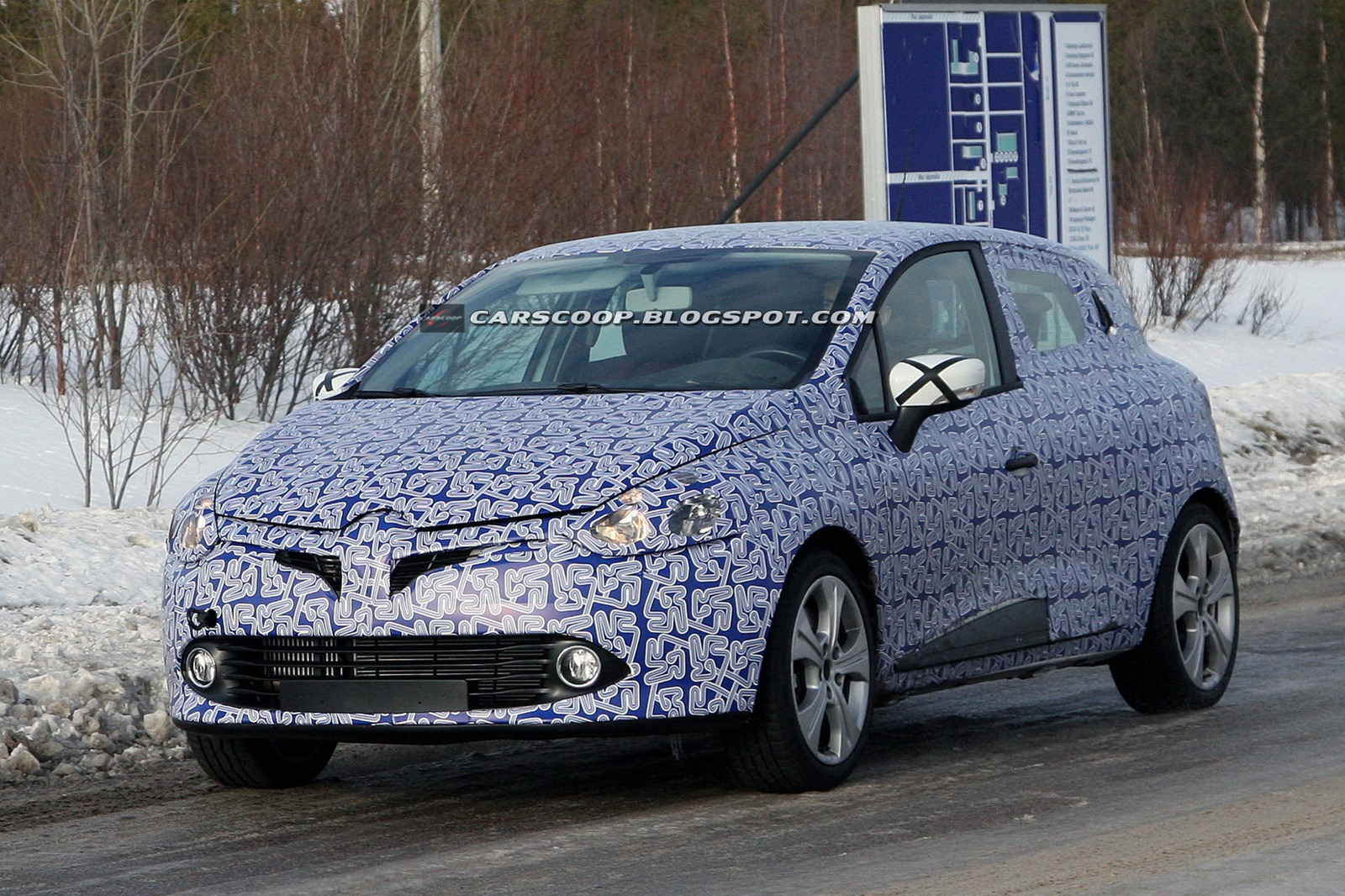
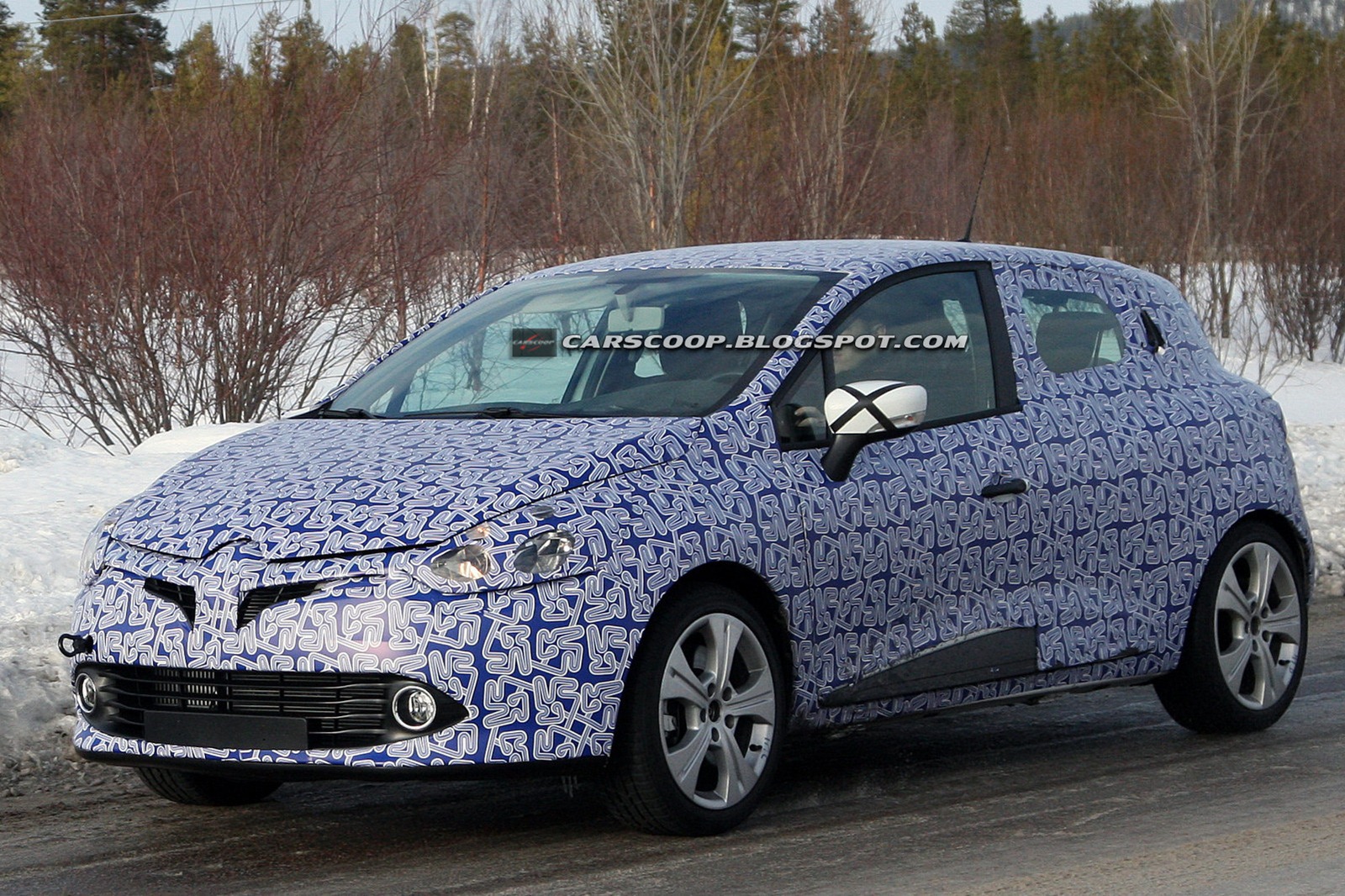
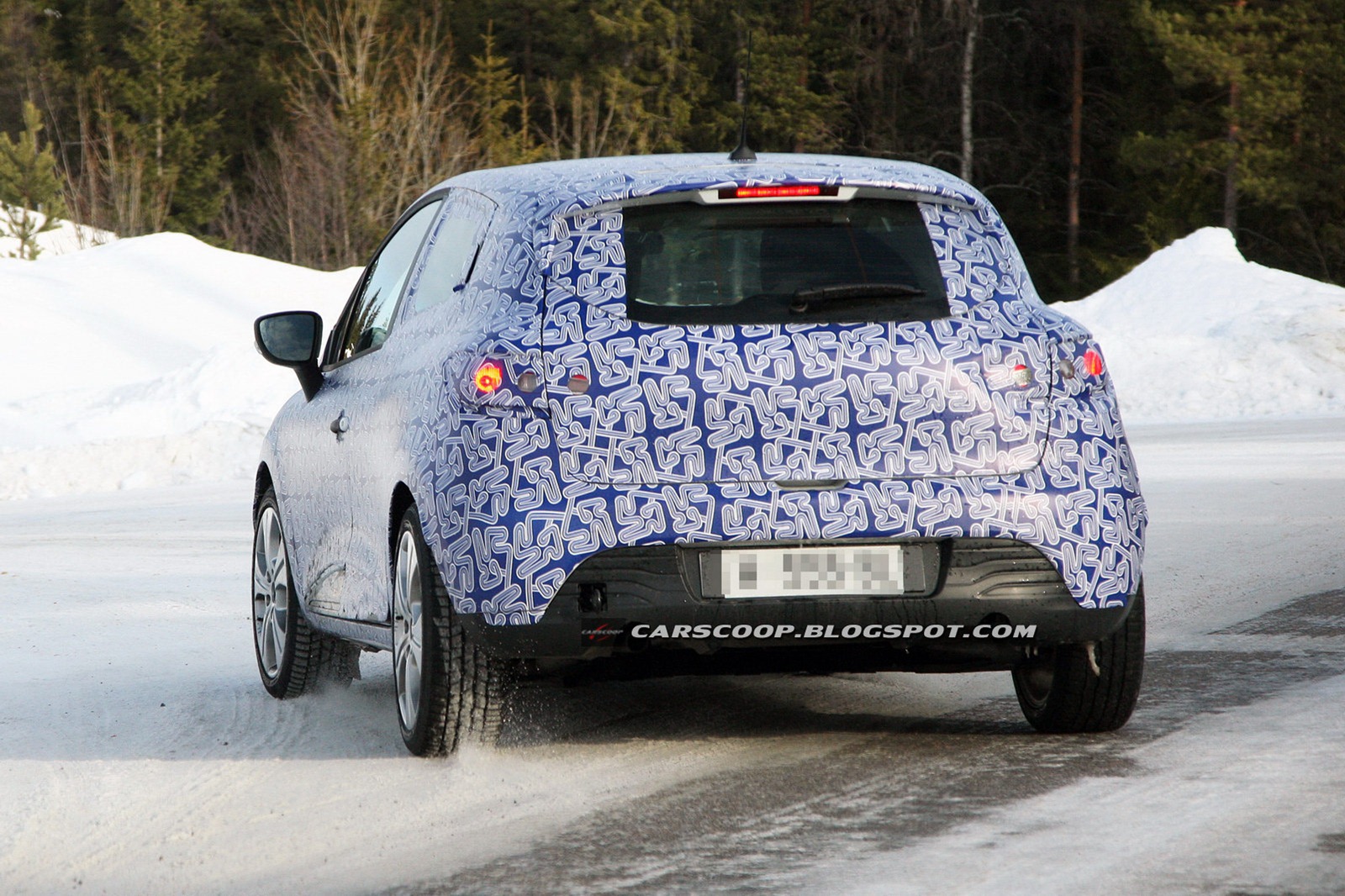
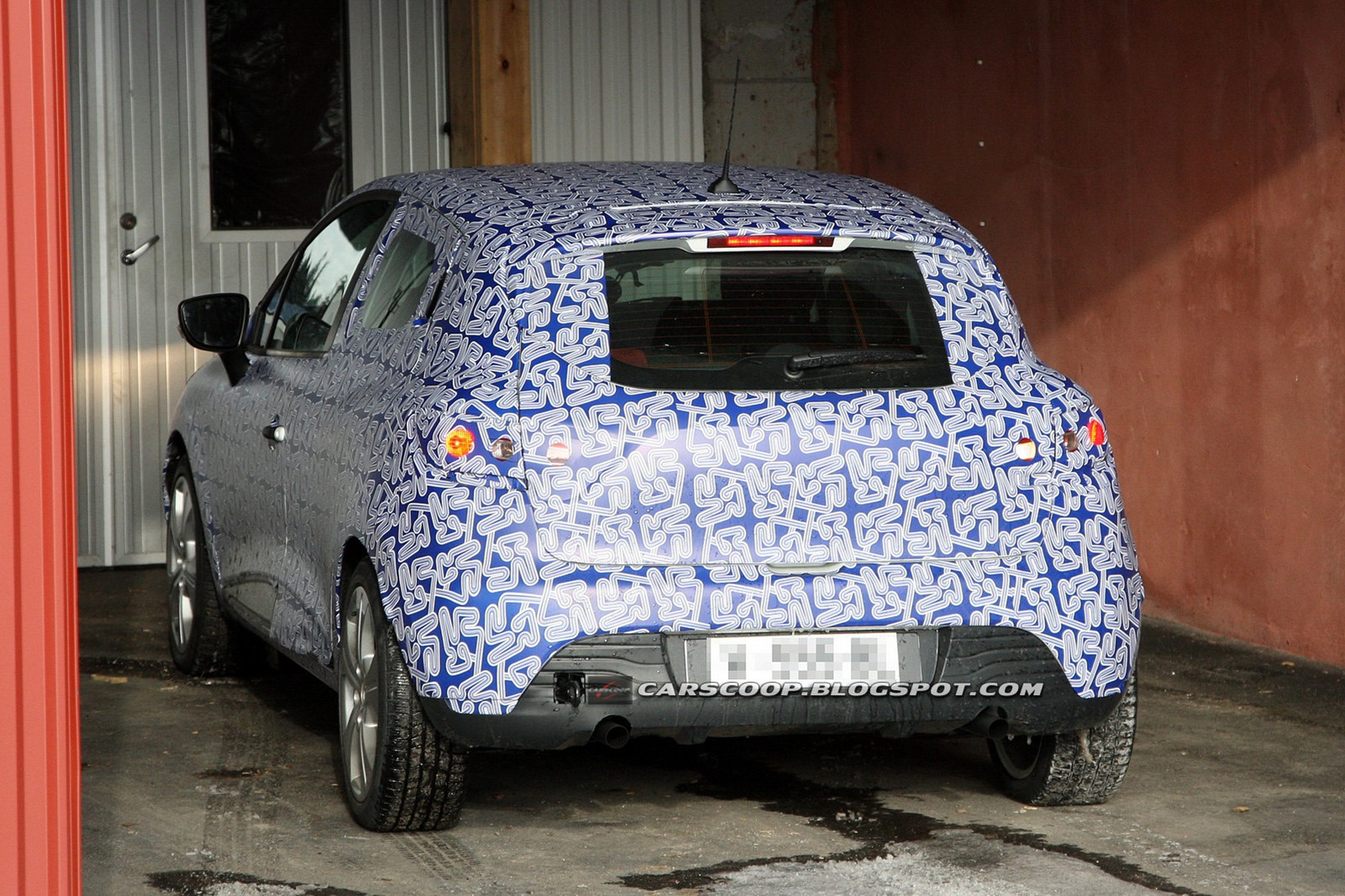
[Antevisão] Renault Clio IV

Este:
3_4_av_clio_4_schulte_d_image_photo_leader.jpg

Nesse caso, fora alguns pormenores e proporções.
​

Sim, essa imagem corresponde à realidade, coisa menos coisa.
 
novo-renault-clio-2012.jpg


Claramente, aquele modelo vermelho que vazou na foto não é o novo Clio.
O tamanho dos faróis dianteiros não é igual.
O tamanho da janelinha que antecede a porta da frente, idem.
E no vermelho, a traseira não faz um volume idêntico ao Megane como o novo Clio parece fazer.
E a linha de cintura também não é igual: bem mais subida no Clio.

Este é o Nissan "clio" [;)]
 
Primeiras impressões de condução [;)]

Four million superminis are sold in Europe every year, and the class is currently dominated by the VW Polo, Ford Fiesta and Vauxhall Corsa. So the fourth-generation Renault Clio needs to be something special if it’s going to make an impression.

To find out how it’s shaping up, we travelled 125 miles north of the Arctic Circle to a small town called Jukkasjarvi in Sweden.

Here, at Renault’s winter test facility, we were granted a world exclusive first drive in a new Clio prototype, seven months before the car’s world debut
at the Paris Motor Show.

Even before we climb in, it’s clear the new Clio is heading in the right direction. The current car’s chassis has been carried over, but the body is wider and slightly lower than before, which creates a noticeably sportier stance. Up to 110kg has been slashed from the kerbweight, too – just like this car’s key
rival, the new Peugeot 208.

Our test model was covered in camouflage, but the more muscular bodywork, bigger headlights and wider grille were all visible nonetheless. There will be no three-door version this time around, but as a compromise the five-door car has hidden door handles.

Inside, the dash is angled slightly towards the driver and a tablet-like infotainment screen sits on top. There are soft-touch materials everywhere – Renault admits it has learned lessons in this area while working on joint projects with Mercedes.
The small yet chunky steering wheel features a greater range of adjustment than before, and so do the seats.

Engine choices include a 1.5-litre dCi diesel with either 74bhp or 89bhp, a four-cylinder 1.2-litre turbo petrol with 113bhp and a brand-new 900cc turbo petrol three-cylinder producing 89bhp and capable of 69mpg. We drove the latter. It responded smoothly at low engine speeds, and the small turbo kicked in seamlessly as we accelerated.

Performance was adequate rather than impressive, but Renault assured us that a more powerful version of this engine, to match Ford’s 123bhp 1.0-litre EcoBoost, would follow in 2013.

The car’s handling ability was hard to assess over the low-grip surfaces we drove on, but the suspension seemed slightly firmer than the outgoing Clio’s. The steering also has a faster ratio – 2.75 turns lock-to-lock – which gives it a quicker and more precise response.


"Inside, the dash is angled slightly towards the driver and a tablet-like infotainment screen sits on top. There are soft-touch materials everywhere – Renault admits it has learned lessons in this area while working on joint projects with Mercedes."

Não sei onde é que querem chegar com isto, se é dizer que não têm olhos na cara para avaliar os materiais da Faurecia (é quem lhes fornece os interiores) se é para dizer que aprenderam com alguém que nunca sequer fez um utilitário.

Coisas escritas na autoexpress são muito duvidosas, esta é uma delas. até podem ter chegado a conclusões novas agora materiais macios por tudo o lado num utilitário...nem um Laguna.
 
Última edição:
Já agora Autocar:

"
What is it?


A shed on wheels? Not exactly. This is project X98, or the next-generation Renault Clio, heavily disguised on its final tests in Jukkasjärvi near Kiruna, north of Sweden, prior to its first public appearance at next Paris motor show, and its market launch right after.
The Clio's fourth generation keeps the same platform, albeit deeply modified, with some 110kg taken off it. At launch time, engines will be two new TCE direct injection turbos: a three cylinder, 0.9-litre with 89bhp and a four cylinder 1.2-litre with 114bhp. On the diesel front we'll get two variants of the extensively updated 1.5 dCi, with 74bhp and 89bhp.
The gearbox is the same five-speed manual as the existing Clio but with revised linkage and different ratios. The steering is new, with electric power assistance and a faster rack.
Exterior dimensions remain nearly the same, but tracks are 30mm wider and the car is 30mm lower.

What's it like?

Looking at this disguised PT1 (code for the first 150 prototypes made in the production line, in Turkey) you wouldn't say it's a car, let alone a new Clio. But we can guarantee it is, having seen the final version five days earlier, at Renault's top secret Technocenter, in France. Unsurprisingly, it looks much better than the old car, now seven years old.
The interior gets a fixed tablet called the R-Link that can be uploaded with 50 different apps. Seats are improved – the driving position benefits from that and also from the steering wheel's more upright positioning and more generous adjustments.
A frozen lake, with minus 18 degrees Celsius, is hardly the best environment to test a new model, even with a reassuring 40cm of ice between feet and water.
We tried the 0.9 TCE-engined version. It takes less than a second to start up, even from extreme cold and idles with just a hint of its three-cylinder architecture. Soundproofing is thicker than on the four cylinder and the end result is good, you only feel some minor vibrations in the seat.
At very low revs it moves the car with ease but after 2200rpm it is obvious that the torque curve gets to its maximum, even if the engineers from Renault refused to comment on detailed data. It revs up until 6250rpm with linearity and without much added noise.
The gearbox feels considerably more precise and the ratios didn't seem too long. The steering felt quicker but driving on ice is not the best way to evaluate this. Surprisingly, the ice lake had some bumps that showed a suspension tuning capable of dealing with that in a very Renault-like manner: comfortable but with great damping.
Grip depended on whether the wind had blown a layer of snow over the ice. When it hadn't, the handling felt precise and predictable. There's no button to disconnect the ESP but it's action was very discreet and helpful. All in all, the car felt light, eager to accelerate and much more solid than the old Clio.

Should I buy one?

If you're looking for a supermini, by the end of the year you'll have a lot of good cars to choose from. We're sure Clio will be one of them. The three-cylinder turbo 0.9 is lively and, presumably, frugal, too. Of course we have to test it on proper roads to draw further conclusions, but the first impression was very positive.
It's still early days to know how much it'll cost. But even with an expected small price rise, it feels like it will be a very strong contender to "frighten the hell out" of cars like Fiesta, Polo, Corsa and 208, as Carlos Tavares, Renault's CEO, told us in France.

Francisco Mota"
 
Uma ponteira de escape em cada lado, jantes de 17" (mesmo tamanho que equipa o actual Clio R.S.):
​
2013-Renault-Clio-9%25255B3%25255D.jpg

Estaremos na presença da variação mais "raçuda" do Clio?

2013-Renault-Clio-10%25255B3%25255D.jpg


2013-Renault-Clio-11%25255B3%25255D.jpg


Discos de travão de dimensões generosas:
​
2013-Renault-Clio-12%25255B3%25255D.jpg


2013-Renault-Clio-13%25255B3%25255D.jpg

​
 
Apesar de estar camuflado acho que já posso dizer que vai dar um grande baile ao 208 pelo menos na parte estética. Ainda me lembro de ver na Autofoco uma sondagem que houve quando saiu o 207 contra o Clio III e o 207 foi escolhido o mais bonito. Parece que desta vez nem em sondagens. Não que o 208 seja feio mas parece pouco proporcional e a lateral do 5 portas... [:vm)]

Já o Clio IV parece muito mais desportivo e futurista que o modelo em fim de carreira. Sem dúvida a Renault está a remodelar a sua imagem e até agora para melhor! A ver se volta aquela originalidade dos produtos do início dos anos 2000 da gama Renault com as melhoras em fiabilidade que a marca tem sofrido nos últimos tempos!
 
O clio III não sendo feio era muito inferior ao 207 esteticamente, agora o Iv parece estar muito melhor.
Venha a concorrência, só é boa para nós consumidores.
 
Voltar
Superior