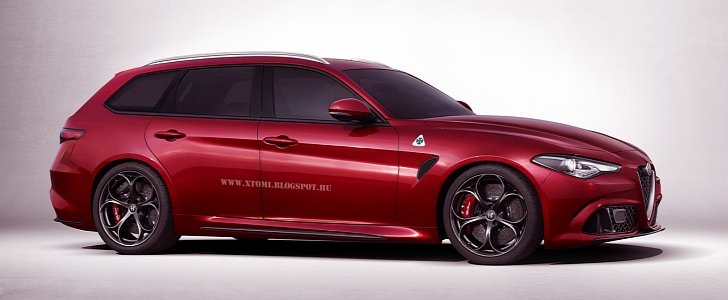
Da malta da EVO:
http://www.evo.co.uk/alfa-romeo/162...vealed-can-alfa-finally-take-the-fight-to-bmw
It’s been hard to take Alfa Romeo seriously in recent years. Its volume models have failed to meet the lofty expectations pinned on them by press and public alike, while
evo has never quite gelled with the carbon-tubbed 4C sports car.Perhaps the new Alfa Romeo Giulia, a rear-wheel drive saloon aimed squarely at the BMW 3-Series, Mercedes C Class and Audi A4, will finally be the car to reinstate Alfa Romeo as a modern car company to truly admire.
On paper at least, the company finally seems to have hit the mark. Part of that is down to the all-new rear-wheel drive architecture, which promises dynamism lacking in the firm’s recent front-wheel drive models. There’s also promise in the sophisticated suspension setup, comprising double wishbones up front and an ‘Alfalink’ multilink setup at the rear axle.
The setup features a ‘semi-virtual steering axis’, designed to maintain a constant caster trail in corners for more accurate steering. Electronically-controlled active dampers are also part of the dynamic package. These will doubtless respond to the latest version of Alfa’s DNA system.
A characteristic of many previous Alfa Romeo performance cars has been a fast steering rack. That shouldn't change in the new car - speaking to engineers on the car's launch in Arese,
evo has learned that the Giulia has distinctly sharp steering, not unlike Ferrari's 458 Italia.
Other electronics are applied only where needed to improve the driving experience. That means torque vectoring is employed to harness power to the rear axle, rather than reining in the handling with an invasive stability control system. The system can also be switched off entirely. Alfa also says its Integrated Brake System results in ‘record-breaking stopping distances.’
Most exciting of all is the prospect of an a new Giulia Quadrifoglio. Engineering expertise from Ferrari has resulted in a turbocharged, petrol V6 with 503bhp and a 3.9-second 0-62mph dash – both more powerful and significantly quicker than the short-run 8C sports car with its Maserati-derived V8. Philippe Krief, engineering chief on the Giulia project, says the company has eliminated turbo lag from the large unit.
Alfa hasn’t confirmed the Quadrifoglio’s weight, but claims the car has a power-to-weight ratio of under 3kg per horsepower suggests a kerbweight in the region of 1500kg. A carbonfibre propshaft, bonnet, roof and seat frames minimise weight, while the front suspension domes, front and rear subframes, wings and doors are formed from aluminium. The rear cross-member is an aluminium and plastic composite, while the brakes feature aluminium calipers and carbon-ceramic discs.
Cylinder deactivation technology helps mitigate turbocharged engine’s thirst – though currently, exact numbers are thin on the ground - while its aluminium construction contributes further to the car’s relatively low mass.
The technology continues on the car’s exterior. Its styling is likely to divide opinion, though there’s no confusing its progeny. The Quadrifoglio features an active front splitter and at the rear, a lip spoiler and large rear diffuser are readily apparent. No images of the standard car have yet been released, though it’s safe to expect a less aggressive styling package and smaller wheels than those of the range-topper.
At some stage, all-wheel drive will also be available. Further powertrain details and images will follow soon.
The new Giulia is part of a 5 billion Euro investment by Fiat Chrysler Automobiles to yield seven new models over the next three years, and take Alfa from a company that sold 74,000 models worldwide in 2013 to 400,000 in 2018.
Interestingly, FCA president Sergio Marchionne suggests the firm's approach with Jeep - going back to its core products and tradition - should work similarly well for Alfa.


Front-view of the Alfa Romeo Giulia Quadrifoglio, BMW M3, Mercedes-AMG C63 S, Jaguar XE S, Volvo S60 T6 and Audi S4
Side view of the Alfa Romeo Giulia Quadrifoglio, BMW M3, Mercedes-AMG C63 S, Jaguar XE S, Volvo S60 T6 and Audi S4.
Rear-view of the Alfa Romeo Giulia Quadrifoglio, BMW M3, Mercedes-AMG C63 S, Jaguar XE S, Volvo S60 T6 and Audi S4
Interior view of the Alfa Romeo Giulia Quadrifoglio, BMW M3, Mercedes-AMG C63 S, Jaguar XE S, Volvo S60 T6 and Audi S4


 ]. Alfa nos EUA ao nível da Porsche? Tenho quase a certeza que não, isso é altamente improvável, eles não são tão parvos quanto isso.