F1 - 2012

O Newey é bem capaz de ficar para a história como o melhor designer da F1.

Desenhou carros ganhadores (que me lembre, na Williams, na McLaren e na Red Bull) e ainda esteve presente em carros que nos ficaram na memória (como os March com as cores da Leyton House).

Aliás, ver este March levou-me aos tempos em que o Capelli "voava baixinho" com um. Oh raios, estou a ficar menos novo! [:D]
 
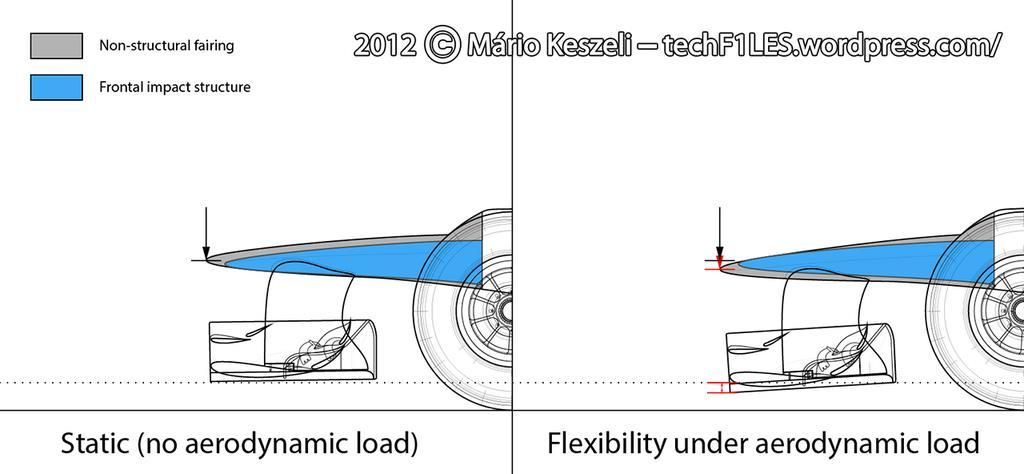
Já agora, uma explicação para alguma da flexibilidade:

665789_525288934166588_235751001_o.jpg


No entanto, pelo que sei, a asa só pode flectir 20mm.

A ideia está bem desenhada, mas penso que funciona ao contrário do exemplificado.

Quanto mais carga, mais o nariz sobe, efeito do que realmente interessa que é a perda de carga na asa. Ao ser empurrada pelo ar, a 'traseira' da asa vai baixar. Perde em downforce mas ganha em velocidade de ponta.
 
Não, é mesmo assim. Vi fotos onboard a baixa e alta velocidade e o nariz baixa com a velocidade, não sobe. Eu percebo que assim, supostamente tem o feito contrário, ou seja, criaria mais downforce, mas a verdade é que é mesmo assim. E penso que a vantagem aerodinâmica se consegue com o menor ângulo de ataque do bordo de ataque da asa.
Aqui também referem isso:


Red Bull 'rubber nose' flexing confirmed

On Red Bull RB8 At GP Abu Dhabi

Red Bull has drawn attention to its flexing front wing again at the recent Abu Dhabi GP. When changing the nose cone of Sebastian Vettel's RB8, it was clear that mechanics could easily bend the nose cone. Footage has also shown that when hitting the kerbs hard, the nose shudders, creating a tilting effect for the front wing.

While this may be new to many, Red Bull's bending nose has been discussed on the f1technical forum since the very first winter tests of this year, and even earlier when you consider previous cars built by Red Bull Racing. Comparative images showed that the tip of the nose of the RB8 was seemingly lower to the ground at high speed than at low speeds. In fact it is an ingenious way to work around the front wing stress tests as those focus on putting weight on each side of the front wing, trying to detect up and down flexing over the entire span of the wing. Red Bull's wings have always passed every test, as the team was able to construct a wing that is strong enough while allowing some flex in the nose to tilt the wing in its entirety when under load.

Experts on the matter have meanwhile also confirmed that it is fairly common to design and produce the tip of a nose to be a little softer to be able to pass the front impact crash test, but none have been found to implement it in such extreme way as Red Bull have done. It is also believed that, while the flexing was present since the beginning of the season, Red Bull's new nose cone, introduced at the Singapore GP further increased the benefits.

Apart from the obvious aerodynamic benefit, one may also have to consider Red Bull using the design to create a mass damping effect, similar to what Renault did in 2005 and 2006 with its tuned mass damper - before it got banned. Although still beneficial, the need for additional mass damping has been drastically reduced since teams started using J-dampers or inerters.
 
Última edição:
Não, é mesmo assim. Vi fotos onboard a baixa e alta velocidade e o nariz baixa com a velocidade, não sobe. Eu percebo que assim, supostamente tem o feito contrário, ou seja, criaria mais downforce, mas a verdade é que é mesmo assim. E penso que a vantagem aerodinâmica se consegue com o menor ângulo de ataque do bordo de ataque da asa.
Aqui também referem isso:


Red Bull 'rubber nose' flexing confirmed

On Red Bull RB8 At GP Abu Dhabi

Red Bull has drawn attention to its flexing front wing again at the recent Abu Dhabi GP. When changing the nose cone of Sebastian Vettel's RB8, it was clear that mechanics could easily bend the nose cone. Footage has also shown that when hitting the kerbs hard, the nose shudders, creating a tilting effect for the front wing.

While this may be new to many, Red Bull's bending nose has been discussed on the f1technical forum since the very first winter tests of this year, and even earlier when you consider previous cars built by Red Bull Racing. Comparative images showed that the tip of the nose of the RB8 was seemingly lower to the ground at high speed than at low speeds. In fact it is an ingenious way to work around the front wing stress tests as those focus on putting weight on each side of the front wing, trying to detect up and down flexing over the entire span of the wing. Red Bull's wings have always passed every test, as the team was able to construct a wing that is strong enough while allowing some flex in the nose to tilt the wing in its entirety when under load.

Experts on the matter have meanwhile also confirmed that it is fairly common to design and produce the tip of a nose to be a little softer to be able to pass the front impact crash test, but none have been found to implement it in such extreme way as Red Bull have done. It is also believed that, while the flexing was present since the beginning of the season, Red Bull's new nose cone, introduced at the Singapore GP further increased the benefits.

Apart from the obvious aerodynamic benefit, one may also have to consider Red Bull using the design to create a mass damping effect, similar to what Renault did in 2005 and 2006 with its tuned mass damper - before it got banned. Although still beneficial, the need for additional mass damping has been drastically reduced since teams started using J-dampers or inerters.

Não tem muita lógica criar mais downforce a alta velocidade, mas sendo assim, deve haver mais alguma coisa escondida.
 
Não tem muita lógica criar mais downforce a alta velocidade, mas sendo assim, deve haver mais alguma coisa escondida.

A questão é que pode não criar, apesar de parecer no papel à primeira vista. É mais complexo do que isso e nós provavelmente nem sonhamos o que o Newey para ali fez.

Por outro lado, já vi também a teoria que cria mais downforce, ou seja, sacrifica um pouco a velocidade em recta mas aumenta nas curvas rápidas.
 
Última edição:
Não tem muita lógica criar mais downforce a alta velocidade, mas sendo assim, deve haver mais alguma coisa escondida.

eu acho que esta solução não é pelo downforce que é usada
para mim, o bico de "borracha" flexivel não é mais que uma versão melhorada dos amortecedores de massa que a Renault usou em 2006? e que foi entretanto banida.
acho que maleabilidade da borracha e oscilações que o bico faz por exemplo, na passagem por correctores, produz o mesmo efeito na redução de vibraçoes

penso eu de que
 
Última edição:
Bem este circuito parece mesmo feito para os RB. Tem ali uma fase que é curva contra curva x 2.

Já a 1ª curva não me parece justificar o alarido que foi feito com ela.
 
Voltar
Superior