reckoner00
Membro participativo
Ainda não vi mais nenhuma noticia relacionada com a posição de CEO da Aston, continuando assim no posto o Ulrich Bez. Mais para o fim do ano devemos saber quem vai ser o sucessor.

Acompanhe o vídeo abaixo para ver como instalar o nosso website como uma aplicação web no seu ecrã inicial.
Nota: Esta funcionalidade pode não estar disponível em alguns navegadores.
What is it?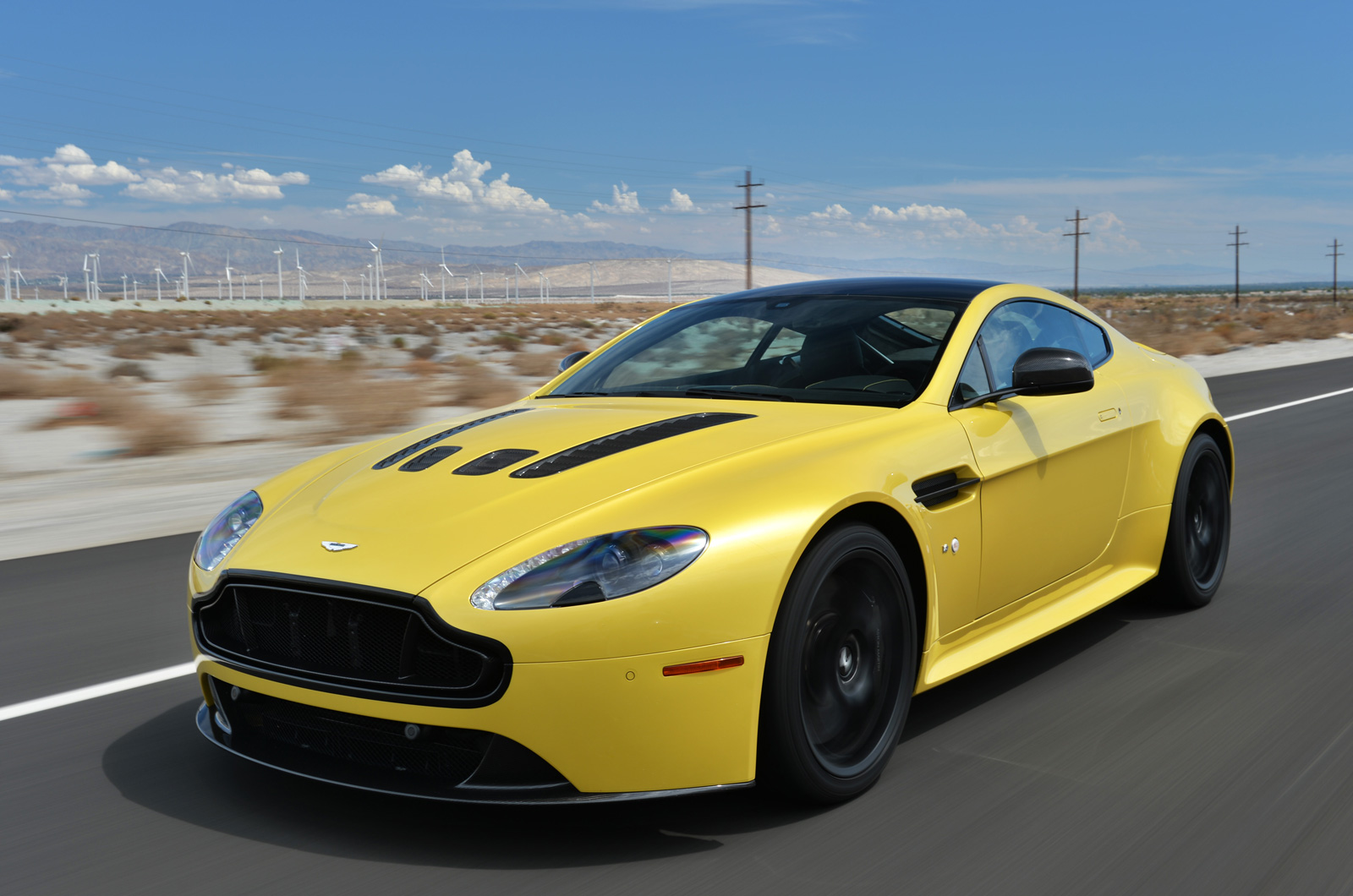
Save for the limited run One-77, the Aston Martin V12 Vantage S is the fastest car to ever leave Gaydon. Here are the headlines: a two hundred and five miles per hour top speed, and zero to sixty-two in just 3.9 seconds.
Like the V12 Vantage before it, the new S is the most raw and visceral model in the Aston Martin range, but with a boost in power and some serious updates it promises even more performance.
Replacing the 510 bhp, 6.0-litre (5935 cc, actually) engine from the DBS is the revised AM28 V12 that makes a staggering 565 horses at 6,750 rpm. Torque is up 27lb-ft at its peak to 457 and the curve is fattened, up especially at the bottom, where 376 lb-ft is available from just 1,000 rpm.
While at idle, the V12 sounds authoritative and commands your attention because there is a disparity between what your eyes see, your ears hear, and what your bones feel. At first glance, you immediately think that a Vantage shouldn’t sound like it has six litres of engine displacement - but this one certainly does.
Outside the car, you feel the low frequency pulses that can only come from a large displacement V12. At full song, it fulfills our wishes for how an unrestrained Aston Martin engine should sound, embodying pure, unbridled aggression.
What is it like?
Whether we like it or not, the manual, six-speed gearbox has been replaced by a decidedly improved Sportshift III seven-speed automated manual. Given that fewer enthusiast cars are available with true manual boxes, it’s no surprise Aston Martin took this direction.
The Sportshift III is latest development of the company’s automated manual that we’ve seen on the likes of the V8 Vantage S, for example. On the positive side, downshifts are impeccable and audibly rewarding, with the right kick of the throttle and perfect timing for clutch release.
After a downshift, the pops and burbles from the exhaust on overrun are simply delightful. In addition, you’ll never be able to make the expensive, potentially tearful, fifth-to-second downshift. Furthermore, this Graziano-sourced box saves 25 kilograms over the old manual transmission.
Compared to Porsche’s PDK and Audi’s S tronic twin clutch gearboxes, the Vantage’s gearbox feels antiquated, but as long as you treat it for what it is – an automated manual – it can be especially rewarding. Upshifts are accomplished faster than a human-operated shift, just not as quick as the latest transmissions.
Remember to lift your foot off the throttle, as you would with a manual box, and upshifts are smooth. On the other hand, keep your foot pinned to the floor on upshifts and the transmission become recalcitrant, lengthening shift time and noticeably impeding your forward progress. The gearbox is, however, more satisfying and effective than any previous Sportshift II we’ve driven and the paddle shifters undoubtedly broaden the appeal of the V12 Vantage S.
Climbing the winding mountain roads near Palm Springs, California in this Vantage and you immediately forget about the gearbox. The same great hydraulically-assisted steering is here, slightly quicker than before and still delightfully unburdened by the weight of the additional four cylinders over the front axle. The revised steering system is enhanced by two levels of power assist, which is tied into the new electronically controlled dampers.
As with the new Vanquish and Rapide S, the V12 Vantage S is also fitted standard with a three-mode Adaptive Damping System from Bilstein. The driver can choose from Normal, Sport and Track modes, but note that Sport mode isn’t simply limited to damping. It also quickens throttle response and speed of gearchanges, and opens further the already sonorous exhaust.
While this may seem like a bit of unnecessary tech, on the ultra smooth asphalt of southern California, Sport seemed to be the perfect all around setting, for the damping, throttle, steering assist, and gear change optimisations serve to enhance the driving experience. These subtle changes make it possible to attack the road with a slightly higher level of confidence than before. That’s what we want from our sports cars, isn’t it?
The excellent carbon ceramic braking system is retained and confirms that Aston Martin still delivers some of the best carbon brakes available today. Lighter weight, ten-spoke alloys, still fitted with Pirelli’s P Zero Corsa tyres, help unsprung weight and, when painted black, look entirely the business.
Some could argue that with 565 bhp on tap, the front 255- and rear 295-section tyres aren’t wide enough, but we’d suggest that this Vantage still retains its exemplary balance. While understeer is rarely present, the degree of oversteer can be dictated by the amount of throttle you wish to use. With the confidence you feel behind the wheel and the chassis’ superb balance, you don’t need to be Darren Turner to exploit its full range of performance.
Changes to the beautiful exterior lines are reserved for a new carbon fibre grille opening and when paired with the signature yellow paint, the effect is striking. Visually, it’s more like art than it is automotive styling.
The American test car was fitted with the standard Sport seat, but the more hard core character of this Vantage demands the available Lightweight buckets. The perfectly positioned, correctly sized, and Alcantara-covered steering wheel carries over.
The interior is unchanged from its refresh in 2009 and while the instrument panel still accomplishes everything that’s expected of a modern car, its styling hasn’t kept pace with the competition. An interior refresh akin to that of the Vanquish would be a welcome update.
Should I buy one?
In a digital world, this mega Vantage is refreshingly analog and its raw, aggressive nature is boldly apparent, just as Aston Martin intended.
If the deeply integrated electronic systems of other sports cars don’t appeal to you - like those found in the new, tech-laden Porsche 911 GT3 - the V12 Vantage S might just have the right blend of speed, style, and character you’re looking for.
Aston Martin V12 Vantage S
Price £138,000; 0-62mph 3.9 sec; Top speed 205mph; Economy19.2mpg; CO2 343g/km; Kerbweight 1615kg; Engine V12, 5935cc, petrol; Power 565 bhp at 6750rpm; Torque 457lb ft; Gearbox 7-speed automated manual


What is it?
The Aston Martin V12 Vantage S, a replacement for the V12 Vantagethat’s been on sale since 2009, but as its name suggests, there’s a sportier edge to it second time around.
Technical highlights?
A quick glance at the spec sheet, or indeed in the cabin, reveals that the biggest change over the (now discontinued) non-S is the switch from a manual to Aston’s seven-speed single-clutch paddle-shift gearbox. This is the first time that Aston has managed to hook the Sportshift ’box up to its 5.9-litre V12 and it has required a switch from a single- to a twin-plate clutch robust enough to handle all the V12’s torque. Talking of which, the torque figure for the S has improved 37lb ft on the regular V12 Vantage to 457lb ft at 5750rpm, while power is up 55bhp to 565bhp at 6750rpm.
Perhaps just as impressively, low-revs torque (measured at 1000rpm) has risen by 52lb ft from an already hearty 324lb ft to a thumping 376. However, there’s an argument that this increase in basement shove could be counterproductive. One of the reasons why the standard V12 Vantage’s claimed 0-60 time was a slightly disappointing 4.1 seconds (and why we could only manage 4.4sec when we tested it) was that it was simply too tricky to translate the torque to the tarmac without a lot of wasteful wheelspin. But the chaps at Aston must have managed to significantly improve rear grip because the claimed 0-60mph time has dropped by more than you’d expect from the power gains and gearbox change alone. The V12 Vantage S will apparently hit 60 from a standstill in 3.7sec (and complete 0-62mph in 3.9), and it will go on to reach a 205mph top speed. The only Aston road car that bests these figures is the mighty Aston Martin One-77.
What’s it like to drive?
We are big fans of the original, but the S is much more nailed down in the corners and revs more freely whilst still retaining that big-hearted character of the earlier car. The ZF Servotronic steering has a quicker rack (15:1 down from 17:1) but also has variable assistance. Thankfully you don’t notice the variable assistance and there’s always a pleasing weight to it.
The seven-speed Oerlikon Graziano gearbox is trickier to get used to. We obviously miss having three pedals and the added interaction that gave in the old V12 – we’d happily forfeit the 25kg weight saving the paddle-shift transmission provides to have it back. The paddle-shift is not the swiftest or most modern-feeling system, either. Curiously, the downshifts are brilliant – the ’box never once refused a request and always delivered smoothly with a pleasingly dramatic flare of revs. It’s the upshifts that are the problem. When you’re going for it and changing up at high revs, the shifts bang through quickly, but if you short-shift or want to drive at less than nine-tenths, the response is awkward and the torque interruption too long compared to most current systems. Having said that, we got used to it over one day, and you doubtless would too if you owned one. If you don’t want to drive flat-out, you can work with it by lifting off the throttle as you pull the right-hand paddle, or better still just not changing gear as much and instead leaning more heavily on the huge well of torque provided by the engine.
There’s no doubt that the V12 Vantage S is the best car Aston currently makes. In spite of the gearbox, or ironically perhaps partly because of it, the S has quite an old-school analogue flavour, certainly more so than something like a Ferrari F12. And despite tech like adaptive dampers, a Sport mode and Servotronic steering, there’s an unfussy mechanical honesty that shines through in the way the short-wheelbase, front-engined (big-engined), rear-wheel-drive layout engages and encourages you to attack the road. The plate-type limited-slip differential isn’t particularly fancy, but it is predictable and trustworthy, which is what you want when the DSC is all the way off. It locks and stays locked to let you happily steer the car on the throttle and tattoo a pair of black lines onto the tar in your wake.
How does it compare?
With 565bhp the Aston V12 Vantage S rivals the Ferrari 458 Italia andMercedes SLS AMG GT, though its £138,000 price tag is something of a minor bargain compared to them, sitting closer to the new £140k Porsche 911 Turbo S. The V12 Vantage S’s technology isn’t as slick as any of them, but it is perhaps the most charismatic of the bunch and we’d argue the prettiest.
Anything else I need to know?
You can read a full feature on the new Aston Martin V12 Vantage S in issue 189 of evo, on sale today (9 October 2013). And the carbon bits that contrast with the paint are optional. As is the lurid yellow paint itself…
- A harder, faster V12 Vantage
- Gearbox far from perfect
Aston Martin will resist building a hybrid-powered sports car for as long as possible and will continue to offer V12 engines for the foreseeable future.The boss of the British sports car brand, Dr Ulrich Bez, has rubbished the latest generation of petrol-electric hypercars such as the Porsche 918 Spyder, Ferrari LaFerrari and McLaren P1, claiming the additional weight of the batteries spoils the purity of extreme machines and the benefits of hybrids are not want elite customers desire.
“We will not have a hybrid in next year or the year after,” he said during the launch of the Vanquish Volante convertible and Vantage V12 S in Palm Springs this week.
“Hybridisation has two aspects; like in F1 to pass someone, which is irrelevant on the road, and the other is to be more fuel efficient. But it is very simple; if you drive a little slower you will be much better off.”
Bez believes there are still greater improvements to be made in terms of aerodynamic efficiency, reducing weight and improving the economy of petrol engines, including downsizing the capacity, before accepting that hybrid is a possibility for Aston Martin.
“I am a purist and I think a sports car should have as low weight as possible. It should be in as minimalistic as it can be and this does not work with hybridisation,” he said.
“I don’t think it is necessary to give me a power shot on the road. I don’t think I need something that gives me 100hp more. I do not know why I need an extra 100kg just to get those things.
“I think a pure sports car does not need this.”
However, the 1700kg weight of Porsche’s 918 Spyder (or 1640kg with the optional Weissach performance kit) is lighter than many of Aston Martin’s sports cars. The hybrid LaFerrari is also significantly lighter (at about 1300kg), as is McLaren’s P1.
Bez also has concerns over the reliability and longevity of complex electrical systems.
“I think it is great technology, but if you think about the biggest failures in cars these days it is electrical failures. And what we do is make more and more electrical systems and we believe it will be much better.
“Maybe I am too old for those things. Minimalistic engineering is where we should be and not in those things.”
He also re-iterated how important the V12 engine is to Aston Martin, and is confident the British brand will be able to continue with the layout for some years to come, hinting that a smaller capacity option may be open to them when it locks-in the technical alliance with Mercedes-Benz that is currently working on.
“I do believe [the V12] is very dear to us,” he said.
“If it comes to a luxury car with emotion, a V12 has something special. This will still be there within the next five to 10 years, but it does not mean it will be six litres - it can be five litres or a smaller one. It will improve with power and fuel consumption.”
“We have already improved every year, and over the past five years we have improved by 30 per cent. We will keep going and doing this with more efficient engines, less weight and aluminium and carbon.
“I will exhaust any limits the regulations give me. We will meet all legislations standards to reduce CO2, but we will do this with higher efficiency."
Prodrive has announced they have received a "record £15 ($23.8 / £17.7) million order for supercar composite body structures" from "one of the world’s most prestigious vehicle manufacturers." The company declined to elaborate but Automobile Magazine is reporting the components could be destined for a new Aston Martin.
Nothing is official but the magazine speculates Aston Martin has switched to a UK-based supplier for a new supercar. We haven't heard any rumors about a One-77 successor, but Automobile says the One-77 had exposed carbon fiber in the cabin so Prodrive's hint that "the greatest challenge for component finish is on the interior parts" must mean the components are headed for a new Aston Martin. That sounds rather weak, but the magazine points out Prodrive chairman David Richards is also Aston Martin's chairman.
Vi um destes ontem. 45 000€?????

If you’re lucky enough to regularly attend launches for new Aston Martin models, you might begin to feel like Bill Murray’s character in the 1993 film, Groundhog Day. You’ll swear you were on the same introductory drive several years before, and you’ll need to study the British company’s press releases and closely examine the car’s details to see the changes. Aston’s new cars tend to be iterations of their tried and true styling, chassis, and engines.Conversely, Ferrari is always pushing ahead with new styling, technology, and mega horsepower numbers. Ferrari’s new four-seat sport scar, the FF, is powered by a V-12 that develops 651 hp at 8200 rpm, delivered through the four wheels by a seven-speed dual-clutch gearbox with a separate two-speed gearbox for the front axle. The trick 4RM all-wheel-drive system adds only 90 pounds to the car’s weight. Impressive.
The new Aston Martin Rapide S carries on with a revised version of the VH platform, which traces back to the launch of the DB9 in 2004. The transmission is a traditional torque converter ZF six-speed automatic. It’s perfectly adequate, but it can be caught out at times and isn’t the fastest shifting gearbox on the market. Aston’s fourth-generation “AM11” V-12 engine is full of character and makes good power, but it lacks the spine-tingling brilliance and high-revving nature of Maranello’s V-12s. And the Rapide’s 5.9-liter falls about 100 hp short of the FF’s engine.
I recently spent the day with a new Rapide S at Atlanta Motorsports Park in Georgia, getting a a ton of track time in both dry and wet conditions. It was huge fun to drive. It’s refreshing not having to toggle through switches on the steering wheel and not dealing with a multitude of setting and configurations. The gauges are simple and clear, with no overdone digital readouts and displays. The hydraulic power steering feels pure and honest, telling you exactly what the car is doing no matter what the conditions. You can adjust the balance of the front-engine, rear-wheel-drive Rapide with the throttle. Brilliant.
Maybe Aston’s antiquated technology and shortage of R&D—especially compared with Ferrari—is a blessing for true car guys. In a way, driving the Rapide is like driving a Subaru BRZ or Scion FR-S, because it’s on the opposite end of the scale of hyper-tech cars like the Nissan GT-R.
The Rapide is like a very expensive, much heavier BRZ/FR-S. The Aston and the Japanese twins are rear-drive sports cars. Both are focused. They’re limited in their technology, offering only the kind of features that improve performance numbers without dulling the visceral experience from behind the wheel. The difference is that the BRZ/FR-S was actively developed from scratch as a pure driver’s car, while the Vantage is simpler than its direct rivals because of Aston’s shortage of funds to advance technological development.
Conversely, there’s the Nissan GT-R. I attended the launch of the Japanese supercar outside Tokyo in 2007. Its performance was staggering on the mountain roads in Japan — I had never driven anything quite like it. When the GT-R came to America, I jumped at the chance to drive one again. Like a child who meets a far-too-famous TV star randomly on the street, I was disappointed. Sure, it was fast, but it was like driving a video game. The car left me slightly cold. Having spent a good amount of time in pretty much every Aston built since the original Vanquish, I have never been left with that impression. The feel of an Aston is lovely and organic — analog, if you will.
Spending time in the Aston is proof that car development isn’t an exact science. It was such a pleasure to thrash the Rapide S around the track in Georgia. The balance and adjustability found in the Aston is a disappearing art. Active sway bars, transmissions that only confirm a shift to the driver via a tachometer change, and steering systems by Atari are taking over the car world. Astons are evolutionary and, even if the cars seem repetitive, each new model has been subtly improved. The Aston isn’t perfect, far from it. Still, cars like the Rapide S need to be celebrated and honored, no matter how they stack up against the competition on paper.
With the recently confirmed Aston Martin and AMG partnership being finalised, one could have easily imagined the two sports car manufacturers teaming up to create an all-new vehicle. However, according to AMG, that’s going a little bit too far.
Instead, AMG Chairman and CEO Tobias Moers insisted that the partnership won’t really extend beyond the agreed engine and electronic infrastructure sharing between the brands.
“[Cooperating on a new vehicle is] Too far, I think. First of all, we have to finish everything with the [agreement with] Aston Martin – about the contract and everything about the engine and the electronics supply agreement,” he said.
When discussing the particular engines which we can expect to see in future Aston Martins, Moers stated that AMGs brand-new turbocharged V8s are likely candidates but that won’t prevent AMG from also offering Aston Martin use of its bi-turbo V12 engine slightly modified to comply with ever harsher emission regulations.
Moers then went onto contradict previous reports by suggesting that even though Aston Martin will utilise AMGs engines, it may be given free rein to make them more powerful depending on Aston’s preferences.
“I don’t know [whether Aston would always have lower outputs].
I think it depends on their car. Maybe there’s no need for [a horsepower gap] if their car [is in a non-competing segment]…
“If there is something very exclusive on the market from Aston Martin priced at Euro 200,000 or more, maybe then why not more horsepower than us… Why not?”
“If they do [want to build a Zonda]… then it’s a different story. But as it is Aston Martin [cars], driving performance-wise, driving dynamics wise – it’s not on the level of an SLS. And I think they want not to be there, because they are more a luxury brand. A good brand, a strong brand, no doubt, but they’re not really focusing on that driving performance and driving dynamics. It’s [Aston's line-up] more in competitive set to an SL,” he concluded.


The reason why Aston Martin axed the Cygnet was because theToyota iQ, on which it was based, is being dropped next year, claims Aston chief Ulrich Bez.
“We stopped the Cygnet as Toyota itself will stop the iQ in 2014 and we don’t want to invest any more,” he said.
Bez also revealed his disappointment and frustration that the Cygnet had not worked out as planned for Aston Martin, and outlined some of the developments Aston had wanted for it.
“I wanted to bring it to the US, but there was no support for it,” he said. “I wanted a supercharged engine, but there was also no support.
“We had a great start with [Toyota boss] Akio Toyoda, whom I still have a great relationship with,” Bez revealed. “But Toyota didn’t follow up the support like it does with Tesla and its marketing of other products.
“I think Aston did a good thing with the Cygnet and I’m disappointed it didn’t work out. It’s a great little car, particularly in London. It will be a cult car in the future and will be well looked after.”
Toyota countered that there are no plans to end iQ production and declined to comment further on Bez’s other remarks.
Dutch publication De Telegraaf is also reporting that the Toyota importer in the Netherlands is no longer importing the iQ, and will sell only the models it has left in stock. This is because it has heard from Toyota in Japan that production for Europe will cease in 2014.

I won’t bore you with the details of how my career inevitably chose me (I’ve already told that story. Twice actually.) But what I will tell you is that even though all jobs eventually cause a little jadedness, there isn’t a single day that goes by where I don’t feel incredibly fortunate to get to do this.
But even when your occupation is hunting speed, some days are a little better than others, particularly any day where your office view looks like this. Over time you do become a little numb to the prospect of driving an exotic car, yet every so often, and with increasing scarcity I might add, you make a connection that breaks free of all that.
Indeed there are some cars out there that are just so good, or in terms of personal preference, so right that you can’t help but fall in love with them. There’s no magic formula and it has nothing to do with numbers and statistics, but there’s something incredible when a car finds the perfect balance of all the things we value.
Prior to two weeks ago, I had never driven an Aston Martin. I had ridden in a Vantage in the UK this summer, shot dozens of race cars on track and admired their sleek silhouettes on the streets for years. In fact they’ve long been an aesthetic favorite of mine, with a tantalizing V12 note in the flagship models to boot.

I don’t think I’m alone when I say that I think they probably have the best looking family of cars in the world. It’s a bold statement I know, but get a load of those curves! To an aesthetic-minded person I think the design alone more than justifies the price, but I was intrigued to see how it would actually drive.
To find out, I was invited to a press launch in Palm Springs some two hours east of my home in Los Angles. At first glance, it’s more or less similar to pretty much every car you’ve ever driven. It has a steering wheel, an instrument cluster and some pedals down below.

However that’s about where the similarities end. There’s enough suede lining the cabin to pay for a small home, but that’s all part of the experience. As you’d expect from a car of this price point (just under $185k US) it also has a fairly remarkable starting procedure. One simply inserts the finely tooled glass and metal key into the slot in the dash and gives it a good push. Instantly it gives rise to all twelve cylinders, and with it, your pulse.

#JoyOfMachine indeed, even in #MinimumAttack mode. But of course to see how a car really drives, I would need to actually drive it…
So we strapped in, I selected first gear and we roared away from our hotel in search of some good driving roads.

And this is what we found. It’s a tasty stretch of smooth and twisty tarmac that starts in minus-sea-level-desert and quickly climbs up roughly ten thousand feet (over 3,000 meters) through Southern California’s San Jacinto mountains, earning it the rightful moniker of “Palms to Pines Scenic Byway” or as it’s more commonly known, California State Route 74. Keen readers may remember another stretch of the 74 called Ortega Highway which I drove last year in an E30 M3. The seventy-four is, from end-to-end, unquestionably one of the best driving roads in all of America.
What was even better was that much of it had been recently resealed and was smoother, and grippier, than ever. So we had the car, we had the road and we had an afternoon to see how the two would mesh. It was time to get down to business and starting putting this V12 monster through its paces.
I’m not sure exactly what I expected from the Vantage, but I can’t tell you enough that it definitely exceeded my wildest hopes by some margin. It’s nothing like what my mind’s eye was picturing. As soon as the road began to tighten and cut back over itself the characteristics of this machine were pronounced. Don’t let the refined styling and gentlemen’s pedigree fool you – this is a driver’s car in every way.
With over five-hundred-seventy horsepower on tap I knew the car was going to be quick, and it certainly didn’t let us down in that regard. What I was shocked by was the impressive balance of the car. It rotates effortlessly without so much as a hint of safety-minded understeer, yet it isn’t completely brutal if you don’t want it to be. The chassis is quite rigid and I found the steering communication superb. How something this good looking could possibly be this good to drive is mind boggling. It’s like a Pulitzer Prize-winning supermodel.

After a brief flogging I decided to pull into a cutout to take a breather and have a look at the beauty. I can only imagine how stupid I must have looked when I stepped out of the car, grinning from ear to ear. For the first time in nearly as long as I could remember, I was pleasantly and completely surprised by a car. It was brilliant.
Having driven most of the recent crop of super cars, I had pretty much thought that manufacturers had given up on building sports cars like this. Yet from behind the wheel it felt like I was driving something revived from a lost era. Sure it has a modern feel and plenty of useful gadgets, but the driving experience is completely raw, even downright terrifying if you want it to be. It’s everything that a V12 should be – it even squeals the tires and kicks out the rear with traction control on.
Yet perhaps the most dumbfounding thing about the Vantage S is that the car rewards you handsomely whether you’re driving it or not. I can’t remember the last time I enjoyed driving and/or looking at a car so much. After less than an hour in the presence of this machine it had already won me over, hook, line and sinker.
It was then that I realized something strange had happened, something I’d never really experienced in a press car. I could feel it in my stomach. I had fallen in love.
While I could have quite easily left him for dead in the hills, I decided it would only be fair to go back and pick up Larry to let him have a go behind the wheel. After all, I needed to let my palms dry out a bit before breakfast.
When we arrived at the diner my mind was still grappling with the task of wrapping itself around the insanity that was the car we pulled up in. I started to day dream about what it would be like to own a Vantage, and how many photo shoots I’d have to do to afford one. One day…
Our stomachs stuffed with the taste of French toast still lingering on our lips, we lumbered out of the cafe and somehow managed to squeeze back into our heavily bolstered office chairs. With my new found sustenance came a heavier right foot, and just in time as the road was beginning to open up nicely into the back country.

Freed of the relentless switchbacks, we could now open up the taps and explore all that the twelve cylinders had to offer.
Not that it needed to, but it was on this open expanse of road that the yellow Aston earned even more brownie points. Usually I tire quickly of long open stretches of road, particularly in exotica where all the flaws are typically exposed – poor A/C, crap visibility and high levels of discomfort are the norm – but the Vantage didn’t exhibit any, and proved to be extremely livable. In fact it was so docile in the cabin that my navigator starting snoring.
Eventually the road started getting lively again so I woke up a sleeping Larry with a quick stab of the brakes and pulled onto a shoulder to give him some more seat time, but not before snapping a few more photos of course. It is our job, after all.
At this point I think you’d already have a hard time convincing me that I was looking at anything less than the best car ever made. Every time I stepped out it got a little more difficult to hand over the keys and I realized I was being transformed against my will into a petrol-headed parody of Gollum.
We wants it, we needs it. I could see that the car was having an effect on Larry too. Yes, he wants the precious.
So as to be a good friend and not let the Aston Martin take over my mind completely, I decided to let mister Chen have another spin…
Followed, of course, by yet another meal. Working this hard requires lots and lots of fuel, for both man and machine. Over lunch we chatted about the day’s remaining affairs, like whether it’s wrong to exchange your soul for a Bond car, if we reckon it comes in other colors and planning the remainder of the route.
When I first heard I would be coming to Palm Springs to drive and photograph some Aston Martins, I knew I wanted to make a trip out to one of California’s most bizarre landmarks; the Salton Sea. While the road from the hills to the Sea are nothing to write home about, I knew that the payoff at sunset would be worth the less exciting drive.
What I didn’t know was that there would be roadworks laying down fresh tar on one of the two roads leading to the Salton Sea. Of course it was the one we decided to take.

After what seemed like an eternity, but was in reality probably only fifteen minutes or so, we were under way again. With the sun still fairly high in the afternoon sky we stopped for a quick coffee and then headed out to find the perfect place to watch it disappear.
After another hour or so of driving we eventually found a location that suited our needs. The Salton Sea is a fascinating, if strange place and a lot of people, even those who live in SoCal, don’t even know it exists. It’s a massive lake that is roughly fifteen miles wide by thirty-five miles long and was somewhat unintentionally created around the turn of the 20th century when the Colorado river overflowed.
It’s literally an oasis in the desert, a seemingly impossible expanse of water in the middle of nowhere. It’s not convenient to get to in any way, and tens of thousands of people drive just past it every day on the I-10 freeway without ever realizing it’s there.
Although it might not do much to show off the car’s handling prowess, I knew it would provide the ideal back drop to the end of an incredible day. After living in the desert for almost a decade, there’s something I find calming about the desolation and endless horizon. It waswarm hot, and quiet, and calm. It was perfect (give or take a few degrees).
While we waited for the sun to set, Larry and I walked around the car training our lenses along the car’s elegant curves. I was still completely flabbergasted by this machine, it just doesn’t have a bad angle. What’s more, with every passing minute the light got a little better.
It was during these last few moments of sun that I realized why we do this, why we became Speedhunters. It isn’t normal to skip dinner, drive hours out of your way and sweat your ass off while shooing away flies waiting for the sun to go down. But that’s the reason our site is a little different from everything else: we are a little different.
While most journalists are perfectly content driving exotic cars, jet-setting around the world and staying in five-star resorts, we aren’t. It’s not to say we don’t appreciate that sort of thing, it’s just that any day of the week we’ll turn down food or sleep or sanity in favor of those first and last seconds of daylight. To put it simply, without cars and cameras, my life ceases to have much meaning.
Of course the greatest motivator is doing this to feed an inner need, but we do it for you too. We aren’t interested in simply telling you guys about the latest specs like how many milliseconds it takes to shift or by how many pounds this year’s model differs from the last. Life is short, and those are just details. We’re more interested in the big picture, both literally and figuratively of course.
We don’t just love our job, we live it. Day in and day out and we want to share that excitement with our readers. Going back to the car, I think the reason I like it so much is because I suspect from its manners that it was developed by people who share this passion. What those people have built is a car that is about as good looking and fun to drive as they come. It’s fast and nimble like a super car, but can be subdued and classy like a GT should be.

I think the hallmark of the car is that I can’t think of a time where this car would be inappropriate, which is probably what made it so difficult to give it back. Normally when I’m driving a car with a performance index like this I feel a bit like an obnoxious douche bag. There’s something about the loud manner of super cars that has always turned me off, yet the Aston has all the go and none of the show – it’s sharp and civilized and you feel accomplished behind the wheel. It’s passionate and incredible, but it’s not shouting about it. It’s simply waiting in the fray for those who live and breathe the same qualities to notice it. I don’t really know how else to explain it. It’s perfect. My precious.

Aston Martin envisages a focus on reducing weight before increasing power, according to engineering boss Ian Minards. “It would be relatively easy to lose 100kg from the current car,” he said. “That much could be saved by removing the air conditioning, simplifying the interior and fitting lightweight seats.” Further weight reduction would involve expensive additions such as lightweight magnesium wheels and carbonfibre body panels.
The design focus would be on producing a lightweight, high-downforce car based on lessons learned over years of competing with the Vantage in the SP8 category of the Nürburgring 24 Hours race.
However, CEO Ulrich Bez confirms that considerable development potential remains in the 565bhp 5.9-litre V12 motor. “We could get more power than we have now even if we made the engine smaller to help with economy and emissions,” he said.
With the project not yet confirmed, no one is talking specifics. But even a modest power hike to 600bhp and the mooted 100kg weight reduction would boost the power-to-weight ratio from 339bhp per tonne at present to 383bhp per tonne, far beyond the reach of the Porsche 911 GT3 and placing it on a par with the Ferrari 458.
This would be sufficient to knock a couple of tenths off the current car’s 0-60mph time of 3.7sec, a time that could be reduced further still by using the launch control system already available on the Vanquish.
Its top speed would likely fall from its current 205mph though, as a result of both shorter gearing and the drag of high-downforce bodywork, including a large rear wing.
Were the project to get the green light within the next six months, the finished car would be unlikely to make its debut before 2015.

