
DeCeIi
Membro histórico
Os trigémeos a diesel nunca venderam bem! No segmento não se justifica.
Ah pois não... É ver as vendas do Twingo...
Mas o Twingo já é um carro quando comparado com as bailarinas PSA/Toyota e do grupo VW...

Acompanhe o vídeo abaixo para ver como instalar o nosso website como uma aplicação web no seu ecrã inicial.
Nota: Esta funcionalidade pode não estar disponível em alguns navegadores.
Os trigémeos a diesel nunca venderam bem! No segmento não se justifica.


Autohoje - Quatro novos concepts Up em Genebra
O Winter Up é um prenúncio do Cross Up que será comercializado em 2013. O modelo de cinco portas é projetado para os desportos de inverno e pode albergar até quatro pranchas de snowboard ou seis esquis montada sobre as barras de tejadilho. A carroçaria vem em «pure white» e «malibu blue», caraterizando-se ainda pelas proteções inferiores em plástico à frente, atrás e soleiras laterais. O carro também tem ESP com bloqueio de diferencial para lidar com neve na estrada.
Também baseado no Cross Up é o estudo X Up. Foi criado para expedições e aventura off-road, o que se reflete na aparência robusta e uma caixa especial no tejadilho com refletores integrados, bem como nos painéis laterais robustos e proteções inferiores na frente e na traseira. Vem pintado num laranja escuro metalizado com os para-choques e a referida caixa superior com acabamento em antracite. O interior recebe inserções de duas tonalidades na porta, nas soleiras da porta de entrada e uma manete de mudanças especial.
O Swiss Up é um concept que veste literalmente as cores do país e de Genebra (onde será apresentado na próxima semana). No interior predomina a cor porcelana, em especial aplicações no painel de instrumentos, nos apoios de cabeça traseiros e no meio do banco traseiro. Os bancos são em pele castanha alcantara, com costuras contrastantes em cor porcelana. Existe ainda decoração com uma cruz igual à da bandeira da Suíça e na parte detrás dos bancos de couro, tiras frontais com local integrado para canivetes suíços, enquanto os painéis decorativos das saídas de ar redondas são pintados em vermelho Tornado.
Por fim, o Cargo Up, que é uma variante em carrinha de cidade. O volume total é de 1400 litros e 426 kg de carga útil. Ideal para profissionais de entregas, tem uma plataforma de carga plana, tanto no lado do passageiro como no porta-malas. Tem um fecho duplo fundo e o vidro traseiro em Plexiglas, o que assegura visibilidade para a retaguarda. Surge decorado com várias cruzes suíças na carroçaria, que foi levantada em 15 mm do solo, barras de tejadilho e proteções inferiores laterais, à frente e atrás e é animado por um motor de 60 cv.


 ]

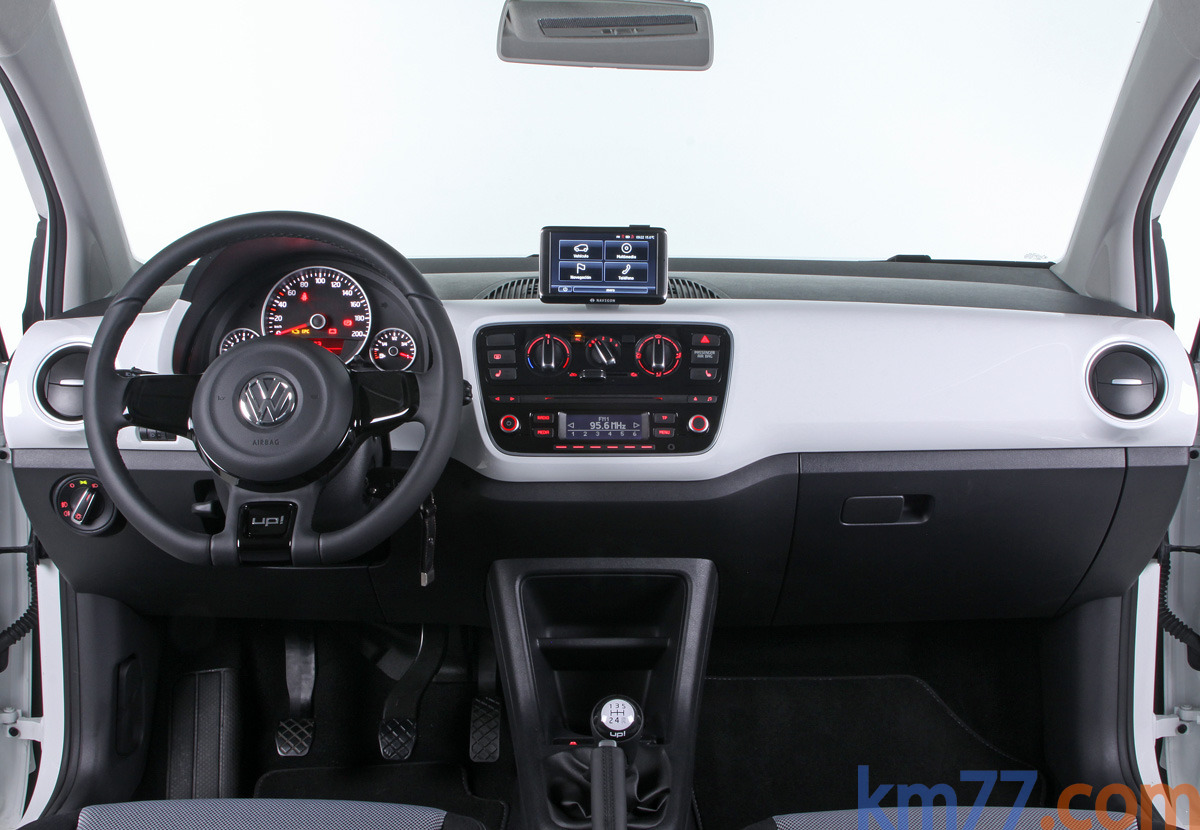
É a primeira vez que vejo os 3 pedais em plástico .
in CARThis is the tale of two Volkswagens. One risible. One righteous.
The new VW Up is a brilliant little car. From its tough yet well-textured cabin, to its composed ride quality, to its tuneful three-cylinder engine, to its outstanding space efficiency, this is one of the finest small cars I’ve driven. Unlike the brilliant Audi A2 – the Volkswagen Group’s last good baby car – there is no technical highlight, no individual game-changing technological step forward. Rather, it is the synthesis of qualities that so endears.
Unlike previous baby VWs – the Fox, the Lupo – that were scaled down Golfs with commensurately scaled down appeal and capability, the Up is every bit as desirable as a Golf. It’s certainly got way more appeal than a Polo, which has always been a dull and dour little car.
VW Up – spoilt only by its name
I just wish it didn’t have such a silly name, made worse by the exclamation mark. And by VW’s insistence that ‘up’ should be spelt with a lower case ‘u’. Thus, up! (I shall ignore both ungrammatical diktats, of course.)
And we thought VW had plunged to new naming depths with the Sharan…
Only the new Fiat Panda – less polished in cabin quality yet slightly superior in driving demeanour – is its class equal.
The VW Beetle – nostalgic codswallop
The latest iteration of the Volkswagen Beetle is a noticeable improvement over its pathetic predecessor, the cartoon-character New Beetle that tried to milk all the Herbie Rides Again nostalgic codswallop but made such a terribly poor job of it. No wonder sales were poor in Europe. Its retro contemporaries, the new Mini and the new Fiat 500, were much more convincing efforts at reinventing prized old nameplates. Much better loved, too. They managed to mingle 1950s ‘classic’ design cues with motoring modernity. Rather than merely a pastiche Beetle body on an innocent Golf platform.
You don’t need to know anything about the old 500, or the classic Mini, to yearn for a new Mini or 500. The new ones stand alone as good characterful cars. The proof of this is that the latest Mini’s biggest market is the US – where (apart from a few years in the early days), they never sold the old one. Same in China, where the old Mini was about as visible in ’60s Shanghai as miniskirts and Beatlemania. Yet the Chinese now love the latest Mini.
Better than the last one – but not good enough
The Beetle on the other hand only works for sad old nostalgists. The new one has a slightly more sensible shape – flatter of roof and squatter of stance – but its remaining semi-circular shape (redolent of the old Bug, of course), makes absolutely no sense when you have a Golf-style front engine/front drive layout.
The old Bug’s shape was fine for a rear-engine rear-driver (the 911’s rear end, after all, isn’t so very different). But it’s stupid for a conventional mechanical layout. It merely means more length and weight. And less rear seat room and boot space.
This is not form following function. It’s foolishness following fashion.
The new New Beetle drives well. That’s not surprising. Underneath it’s a Golf. But in most other ways it’s an engineering and packaging compromise that should be avoided by all forward-thinking people. Just buy a Golf. Or, as four seats apparently seem to be enough, an Up.

FRANKFURT/MADRID (Bloomberg) -- Volkswagen has failed to find one true successor to the original Beetle, so it's trying out several to tackle the market for affordable, basic transport.
Following flops by the VW Fox and Lupo, the German automaker is transforming the Up city car into a family of entry-level vehicles to grab market share from Fiat, whose Panda is Europe's best-selling minicar, and reach its goal of selling 10 million vehicles a year by 2018.
Volkswagen's Skoda and Seat brands are both selling Up clones and a cut-rate version will be targeted for first-time buyers in markets including China, Brazil and India.
"The Up is a fundamental milestone" for VW to reach its sales target, said Albrecht Denninghoff, an analyst with Silvia Quandt Research in Frankfurt. The city car's expanded lineup will "really increase the pressure on the competitors in the segments in which they make their money."
Sales of minicars and subcompacts are rising as buyers seek cars for driving in urban centers and governments push automakers to build vehicles that burn less fuel.
Sales of minicars like the Up and Fiat Panda could rise 25 percent globally to 11.2 million by 2015, according to IHS Automotive.
After moving upscale with models like the 68,300 euro ($89,400) Phaeton sedan and the trendy, 16,950 euro new Beetle, the shift back to basic cars marks a key test for CEO Martin Winterkorn, who ordered the Up's development after he took charge in 2007 to help turn the company into the world's biggest automaker.
'People's car'
VW became a global automotive power on the back of the Beetle, the original "people's car," which went out of production as basic, inexpensive transportation in 2003 after more than six decades.
Volkswagen has failed to gain traction in this segment, with the 9,850 euro ($12,860) Up marking its third attempt to build a globally successful minicar.
The broader array of Up-based offerings is geared at lowering per-vehicle costs to compete with the Fiat Panda, Renault's Twingo and the Peugeot 107 from PSA/Peugeot-Citroen for customers like Wendy Mountford.
The 53-year-old English teacher shunned the Fox and Lupo three years ago when she was looking for a cheap, reliable car for her daughter. The VW models were "just too expensive," said Mountford, who lives in Zorneding near Munich and previously owned two Golf hatchbacks, a Scirocco coupe and a Passat wagon.
The VW models "were very fuel efficient, but you had to have them 10 or 12 years before you got your money back," she said.
New Small Family
With Volkswagen adding five-door and electric variants in 2013 to what it calls the New Small Family, which already includes the Skoda Citigo and Seat Mii, the Up models will outsell the Panda, Twingo and 107 by the end of that year, according to estimates from IHS Automotive.
VW halted production of the Lupo in 2005 after sales of the vehicle missed targets during its seven-year lifespan. Exports of the Fox, which is still built in Brazil, were squeezed by the appreciation of the real against the dollar.
While the first generation of the car is unlikely to be profitable, according to analyst Denninghoff, it will serve to attract first-time buyers to Volkswagen brands who might then buy more expensive models.
"Our issue is not so much about making the platform profitable, but to use it to increase the potential of the brand and loyalty," Paul Sevin, Seat's vice president for sales and marketing, said in an interview at the company's headquarters in Martorell, Spain.
VW sees the Up winning over more than 100,000 new buyers per year, the brand's marketing chief, Luca de Meo, said in August.
'Anti-crisis' car
The Up's various versions each have a different function. For Seat, the Mii is seen as an "anti-crisis" car aimed at winning market share in Italy, France and Spain, Sevin said. "We can begin with an entry price in the category, so it's a very good answer in this time for reconquering customers," he said.
Seat's 225 million euro loss in 2011 made it VW's only unprofitable automotive unit. The Mii starts at 8,890 euros, undercutting the 9,650 euros Peugeot charges for the most basic 107 and the 9,990 euros Fiat and Renault ask for the Panda and the Twingo.
Skoda said it's breaking away from its focus on male drivers with the 9,450 euro Citigo. "We're now targeting here new customers for the brand -- a slightly younger, more female audience," Skoda sales chief Juergen Stackmann said in an interview in Prague. "Citigo allows us to move into a more emotional market with more emotional customers -- for us it's a completely new endeavor."
Volkswagen is also developing a version of the Up geared to the South American market that should arrive in 2013. Editions for India and China are also under consideration, said Ulrich Hackenberg, head of VW brand development.
'An experiment'
"The Up definitely has the potential to mobilize broad strata of the global population," Hackenberg said in an e-mail response to questions. The model line "will be a very important component of our 2018 growth strategy."
Still, scaling back a car for low-price markets is "an experiment which so far has never worked out," said Frankfurt- based IHS Automotive analyst Christoph Stuermer. "That is what makes the car in its second life strategically much more important than simply another VW. It is certainly addressing very high volume and very high growth potential much more than in Europe."
Buoyed by the emerging market editions, Volkswagen is projected to more than double sales of the Up family to 390,900 in 2015 from 181,400 this year, according to IHS. That may not be enough. The carmaker will struggle to make a profit on the car until annual sales exceed 500,000, Denninghoff said.
Ex-VW owner Mountford ended up opting for a Smart ForFour from Daimler when she bought a car for her daughter to head to university. The good news for VW is that the car's no longer on the market. The bad news is that Daimler and Renault are teaming up to bring it back.
 ]


Uau, que valorização clonal [
Estes carros pequenos dão um gozo enorme de conduzir em cidade...quando associados a motores espovitados (em baixas). Actualmente ando com o do meu sogro, Peugeot 106 de 98, todo artilhado (ar condi****do, jantes, pele, etc..) 1.4 a gasolina e aquilo voa pela cidade...come é muito - 9 litros aos 100, pelas minhas contas...tb tenho um problema de pé no pedal mas isso já se sabe.
Este UP parece-me porreiro ainda que não o tenha experimentado (gosto do que vejo). Eide de faze-lo mas no de 5 portas...dá jeito para transportar aquelas criaturazinhas pequenas agarradinhas ás cadeirinhas...ouvi dizer é que os vidros traserios não abrem, ou melhor não descem...mas tb quantas vezes os descemos...
Este 1.2 no Up gastará quanto?
Cump.
]
O Up para já só tem motor de 1000cc.
A média geral, no Spritmonitor, está de momento em 5l/100, apesar de ainda não haver muitos exemplares registados. Consumos entre os 5.5 e 6 deverá ser o mais expectável.
Mas olhando para alguns valores, ou são fãs acérrimos do hypermiling ou estão a querer enganar alguém[
´Não me parecem descabidos valores baixos de consumo para o Up. Falam aqui muito nesse SprintMonitor, mas estive lá e o pessoal com carro igual ao meu faz médias tão altas que fiquei com a sensação que não era muito fiável...
]
 ]


